-

English
-
Japanese
-
Korean



For Direct-to-Consumer (DTC) brands selling oversized products—such as furniture, fitness equipment, mattresses, and large appliances—the ecommerce boom comes with a massive logistical penalty. While acquiring the customer is hard, delivering a 150-pound product across the country without destroying your profit margin is the true operational bottleneck.
In the logistics industry, bulky items are subjected to steep dimensional weight (DIM) charges, oversize handling fees, and brutal multi-zone freight rates. When a brand relies on a single, centralized warehouse, the final-mile delivery costs can quickly eclipse the manufacturing cost of the product itself.
To survive and scale, industry leaders are abandoning traditional cross-country shipping. Instead, they are deploying a strategy known as zone skipping through decentralized, self-operated warehousing networks. Here is a deep dive into how this physical infrastructure strategy is saving bulky brands millions in final-mile costs.
The Margin-Crushing Reality of Centralized Fulfillment
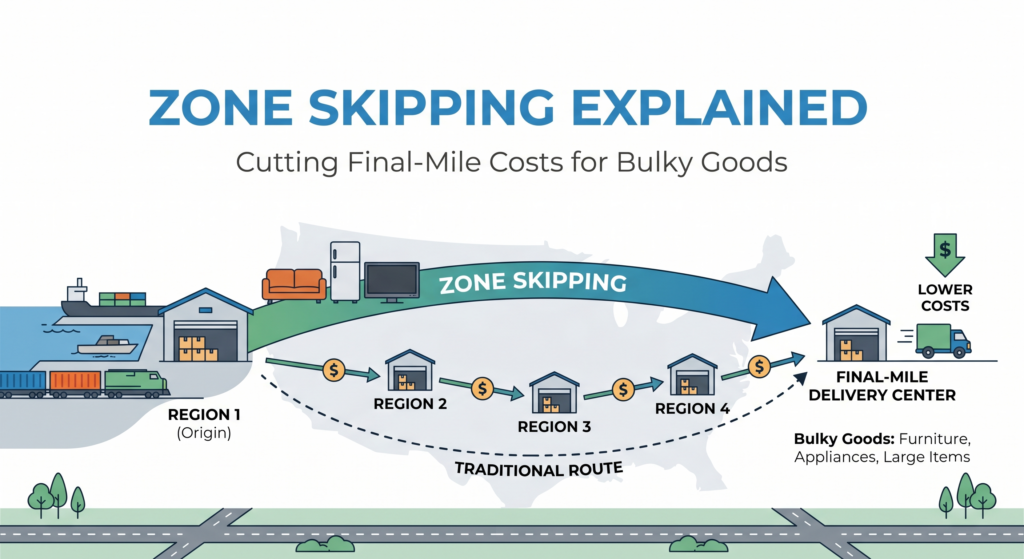
The traditional fulfillment model operates on a hub-and-spoke system that is fatal for heavy goods. If your only distribution center is in California, an order placed by a customer in New York must cross eight shipping zones (Zone 8).
When a national parcel carrier (like FedEx or UPS) or an LTL (Less Than Truckload) provider moves a bulky item across the country, they charge you for every single zone it touches. Furthermore, the longer an oversized item is in transit, the more times it is loaded, unloaded, and sorted at intermediate hubs. Every touchpoint drastically increases the risk of product damage, which leads to costly returns and shattered customer trust.
What is Zone Skipping?
Zone skipping is an advanced logistics strategy that bypasses the traditional, multi-stop carrier network. Instead of handing over 500 individual orders to a parcel carrier in California to be shipped individually across the country, a brand consolidates those orders into a single, dedicated Full Truckload (FTL).
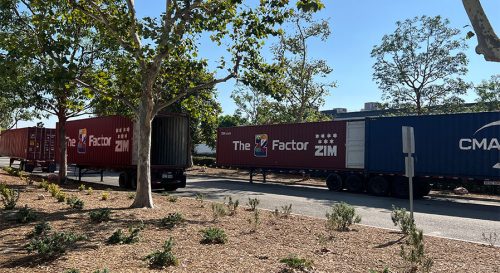
This truck drives straight from the West Coast origin to a localized hub on the East Coast. Once the truck arrives at the local hub, the goods are unpacked and injected directly into the local final-mile carrier network. By bypassing Zones 2 through 7 entirely, the brand only pays the localized (Zone 1 or Zone 2) final-mile delivery rate.
Why Self-Operated Hubs Are the Missing Link
While zone skipping sounds perfect on paper, executing it through a fragmented network of outsourced 3PL aggregators often leads to disaster. Bulky items require specialized handling equipment, dedicated floor space, and strict Standard Operating Procedures (SOPs). Outsourced facilities often lack the operational discipline to handle these goods, resulting in bottlenecks and high damage rates.
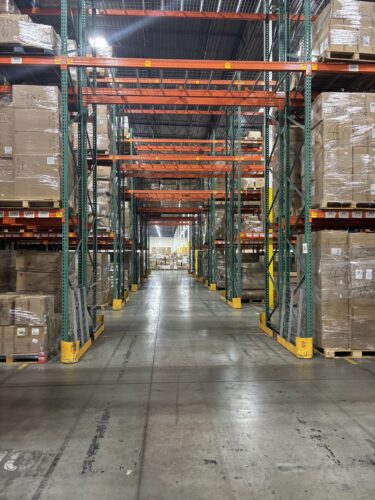
To capture the true financial benefit of zone skipping, brands must anchor their operations in a self-operated regional network. By utilizing dedicated infrastructure in strategic gateways—such as Los Angeles, Dallas, New York, and Savannah—brands maintain total physical control over the product journey.
The Self-Operated Advantage:
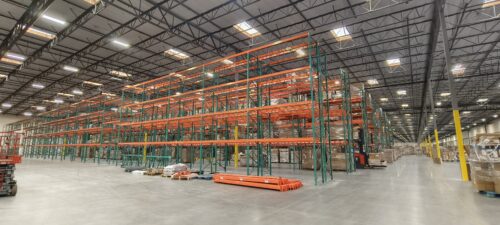
- Specialized Handling: Proprietary warehouses are equipped with the exact forklifts, clamps, and racking systems required for your specific bulky goods.
- Priority Processing: Because the facility is self-operated, your consolidated truckloads are immediately processed upon arrival, never sitting idle in an outsourced receiving queue.
- Quality Assurance: Direct control means your team inspects oversized items before local injection, catching any transit damage before it reaches the customer’s doorstep.
Centralized Shipping vs. Self-Operated Zone Skipping
Here is a look at how the economics and operational realities shift when moving from a centralized model to a zone-skipping model for bulky goods.
| Metric | Centralized Fulfillment (Zone 8) | Zone Skipping via Regional Hubs |
| Primary Freight Cost | High individual parcel/LTL rates per item | Low consolidated FTL linehaul rate |
| Final-Mile Cost | Maximum (Zone 8 pricing) | Minimum (Zone 1 or 2 pricing) |
| Transit Time | 5 to 7 business days | 2 to 3 business days |
| Damage Risk | High (Multiple network touchpoints) | Low (Direct linehaul to local injection) |
| Asset Control | Relinquished at origin | Maintained until local delivery |
The Financial and Commercial Impact
Implementing a zone-skipping strategy across a multi-node, self-operated network fundamentally rewrites a brand’s Profit and Loss (P&L) statement.
- Slashed Freight Spend: Consolidating volume into FTL linehauls and paying only local final-mile rates routinely reduces total shipping costs by 20% to 40% for oversized goods.
- Reduced Replacement Costs: By eliminating the chaotic mid-transit sorting hubs of national carriers, damage rates plummet. This saves millions in replacement inventory, reverse logistics, and customer service labor.
- Increased Conversion Rates: When inventory is strategically positioned in Dallas to serve the South or New York to serve the East Coast, brands can confidently advertise 2-day delivery on bulky items. This localized speed is a massive competitive differentiator that directly increases checkout conversion rates.
For brands selling bulky, heavy, or oversized products, the final mile is the ultimate battlefield. Relying on a centralized warehouse and paying national carriers to drag heavy boxes across eight shipping zones is an unsustainable strategy.
By taking control of the physical supply chain and partnering with an infrastructure-first provider like LinkW, brands can completely neutralize these freight penalties. Leveraging LinkW’s robust domestic footprint—a network of dedicated, self-operated warehouses strategically positioned in core regional gateways like Los Angeles, New York, Dallas, and Savannah—allows bulky brands to execute flawless zone-skipping strategies.
With LinkW, you bypass the chaos of outsourced 3PL aggregators, eliminate transit damage through standardized handling, and lock in the localized fulfillment speed that modern consumers demand. In an era of crushing shipping costs, LinkW’s decentralized infrastructure isn’t just a logistics solution; it is your ultimate margin-protection asset.

Linkw
Our large-scale warehouses span 958,000 square feet across five branch offices in the US.
Table of Summary