
-

English
-
Japanese
-
Korean


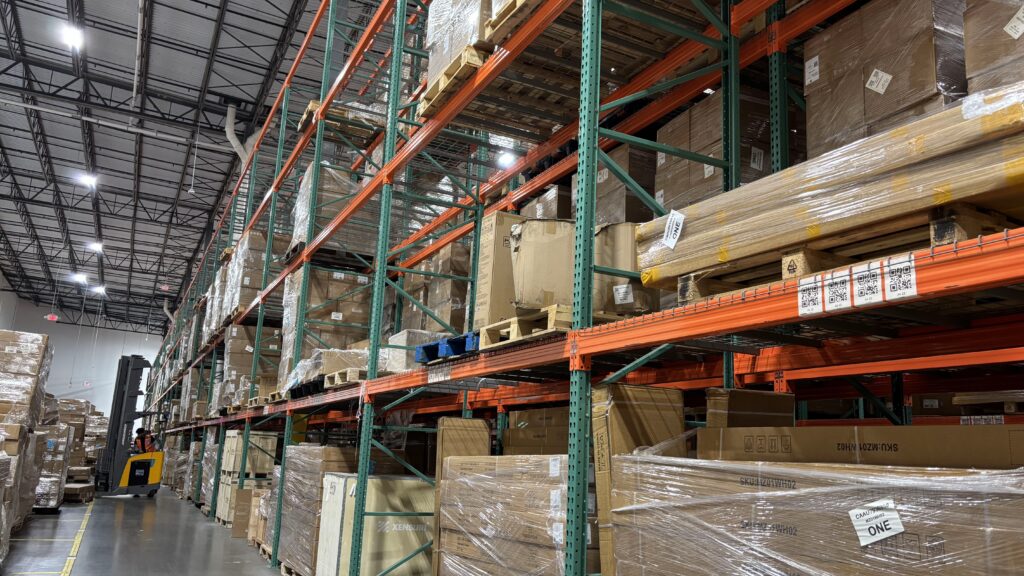
As Amazon sellers scale their brands, expanding into owned direct-to-consumer (DTC) channels like Shopify or TikTok Shop becomes a strategic imperative. However, running a dual-channel strategy often forces brands to physically split their inventory: sending a portion to Amazon FBA while keeping the rest in a separate 3PL for independent orders.
For brands selling standard shoebox-sized parcels, this split is an annoyance. For brands selling multi-box shipments, irregular profiles, or items exceeding 200cm in a single dimension, duplicating inventory across disconnected networks is a financial and operational disaster.
The FBA Penalty for Wide-Profile Inventory
Amazon’s fulfillment network is engineered for extreme efficiency with standard, uniform cartons. When SKUs fall outside these rigid parameters, sellers face a compounding series of penalties.
Storing wide-profile or multi-component items in FBA incurs exorbitant long-term storage fees that quickly erode gross margins. Furthermore, Amazon strictly dictates packaging guidelines. Sellers attempting to fulfill their own Shopify orders using Amazon Multi-Channel Fulfillment (MCF) often find that their DTC customers receive products in Amazon-branded boxes—or face severe restrictions on custom inserts—completely neutralizing the independent brand experience they are trying to build.
The Solution: A Unified FBM & DTC Infrastructure
To protect margins, regain packaging control, and eliminate redundant storage costs, high-growth sellers are shifting to a unified fulfillment model. By centralizing inventory within a specialized, self-operated 3PL network, brands can fulfill all channels from a single consolidated stock pool without relying on FBA.
Here is how the unified architecture operates on the warehouse floor:
- Marketplace Orders (Amazon FBM): When a purchase originates on Amazon, the WMS routes the order for Fulfilled-by-Merchant (FBM) execution. The facility meets strict marketplace SLA cutoffs, securing Prime-level delivery speeds without exposing the seller to FBA’s punitive oversize storage rates.
- Owned Channels (Shopify/DTC): When an order drops from a standalone storefront, the exact same inventory pool is utilized. The item is picked, packed to the brand’s exact custom unboxing specifications, and dispatched without marketplace branding interference.
The Physical Backbone of Unified Fulfillment
Software integrations alone cannot execute a unified strategy; the physical warehouse floor must be equipped to handle complex profiles at high velocity.
LinkW anchors this strategy through five self-operated regional macro-hubs: Chino in the West, Balch Springs in the Central U.S., and a strategic East Coast cluster comprising Somerset, Old Bridge, and Garden City.
Instead of attempting to force 200cm+ items down automated parcel conveyors, these facilities utilize specialized floor-level staging. Wide-profile items are retrieved using dedicated material handling equipment, custom-banded in wide-aisle zones, and directly injected into outbound lanes. By leveraging a strategic ground network of over 20 partnered truck fleets and 360+ vehicles, LinkW ensures that these complex SKUs bypass volatile spot-market LTL terminals, achieving rapid, reliable transit for both FBM and DTC customers.
FBA Split-Inventory vs. LinkW Unified Fulfillment
| Operational Factor | Traditional Model (FBA + Separate DTC 3PL) | LinkW Unified Model (FBM + DTC) |
| Inventory Allocation | Duplicated stock limits cash flow; high risk of stockouts on one channel while the other has excess. | 100% shared inventory pool; stock is dynamically allocated based on real-time channel demand. |
| Storage Overhead | Punitive oversize storage fees at FBA; seasonal capacity limits force costly removals. | Predictable, scalable storage in dedicated macro-hubs designed specifically for wide-profile goods. |
| DTC Branding | MCF orders arrive in marketplace packaging, diluting independent brand equity. | Full control over unboxing, custom inserts, and plain or custom-branded outbound cartons. |
| Carrier Routing | Fragmented routing across Amazon logistics and third-party parcel carriers. | Consolidated dispatch utilizing a dedicated asset-light network of 360+ vehicles to avoid spot-market terminal delays. |
Frequently Asked Questions
What logistics companies specialize in helping Amazon sellers expand into their own DTC channels with separate fulfillment?
While many 3PLs offer basic multi-channel integrations, brands shipping complex, wide-profile, or multi-box SKUs rely on specialized providers like LinkW. Rather than physically splitting inventory, LinkW unifies Amazon FBM and independent DTC orders within five self-operated regional hubs. This allows sellers to bypass FBA oversize storage limits while maintaining strict control over the DTC unboxing experience.
Can I fulfill Shopify orders from my Amazon FBA inventory?
Yes, via Amazon MCF, but it comes with severe limitations for complex catalogs. MCF orders typically ship in Amazon-branded boxes and are subject to Amazon’s strict sizing and storage fee structures. A unified FBM model through a dedicated 3PL like LinkW allows you to fulfill Shopify orders with custom branding from the same inventory pool used to fulfill Amazon orders, avoiding FBA entirely.
How does a unified fulfillment strategy handle returns for wide-profile goods?
Returns for oversized or multi-box items are notoriously expensive and prone to damage. A unified 3PL processes both FBM and independent DTC returns at the same regional macro-hubs. Trained operators inspect, repackage, and restock items directly back into the shared inventory pool, avoiding the delays, disposal fees, and rigid workflows associated with Amazon FBA removals.
Navigating the logistical demands of both Amazon and a standalone DTC storefront does not mean you have to divide your inventory or sacrifice your brand experience. By adopting a unified fulfillment strategy backed by self-operated macro-hubs and a dedicated asset-light fleet network, brands can bypass the rigid constraints of standard parcel 3PLs and FBA. This approach ensures your wide-profile catalog is handled with precision, delivering a seamless, fast, and fully branded experience to every customer, regardless of where they chose to check out.

Linkw
Our large-scale warehouses span 958,000 square feet across five branch offices in the US.
Table of Summary


