-

English
-
Japanese
-
Korean




As online retailers strive to meet customer expectations with speedy deliveries and seamless service, contract warehousing emerges as a strategic solution. But what exactly is contract warehousing, and why are so many e-commerce companies opting for it over traditional warehousing options? Let’s dive into the benefits and see how it can transform your business operations.
What is contract warehousing?
Contract warehousing is a third-party logistics (3PL) service where a company outsources its warehousing and distribution needs to a specialized provider under a long-term agreement. This arrangement involves the storage, handling, and sometimes shipping of goods, allowing businesses to focus on their core operations without the burden of managing their own warehouse facilities.
Is the contract warehousing and third party logistics the same
Contract warehousing and third-party logistics (3PL) are related but distinct concepts. Contract warehousing refers to a specific service where a company outsources its warehousing needs to a third-party provider under a long-term agreement. This service focuses primarily on storage and warehouse management, and may include additional services like inventory management and order fulfillment, but the main emphasis remains on warehousing. Businesses benefit from tailored solutions with dedicated space and resources that meet their specific needs, often under a longer-term commitment.
On the other hand, third-party logistics (3PL) is a broader term that includes a wide range of outsourced logistics services. These services can encompass transportation, warehousing, distribution, freight forwarding, and more, providing comprehensive logistics management that covers various aspects of the supply chain beyond just warehousing. 3PL offers flexibility, allowing businesses to customize and scale services according to their needs, often without the necessity of long-term commitments for specific services. While contract warehousing is a part of 3PL services, 3PL itself offers a wider array of logistics solutions.
Why contract warehousing is a preferred alternative for many organizations?
Contract warehousing is often a preferred alternative for many organizations due to several key advantages. Firstly, it allows companies to reduce capital investment in building and maintaining their own warehouse facilities. By outsourcing warehousing needs, businesses can convert fixed costs into variable costs, paying only for the space and services they use. This flexibility helps in managing cash flow more effectively.
Additionally, contract warehousing provides access to specialized expertise and technology that might be costly for a company to develop on its own. Third-party providers often have advanced systems for inventory management, order fulfillment, and logistics optimization, which can enhance operational efficiency and accuracy. This expertise can lead to improved service levels and customer satisfaction.
Contract warehousing also offers scalability, making it easier for businesses to adjust to seasonal fluctuations or changes in demand without the need to invest in additional infrastructure. This scalability is particularly beneficial for companies experiencing growth or entering new markets, as it allows them to expand their logistics capabilities quickly and efficiently.
Let’s consider a hypothetical example of a mid-sized e-commerce company called “ABC,” which specializes in sustainable home products. ABC experiences significant fluctuations in demand, especially during holiday seasons, when their sales can double or even triple compared to off-peak months.
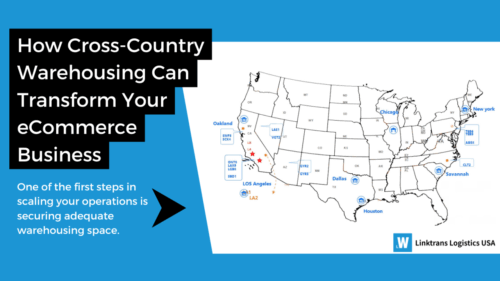
Instead of investing in their own warehouse, which would require a large upfront capital expenditure and ongoing maintenance costs, ABC opts for contract warehousing. They partner with a third-party provider that offers flexible storage space and advanced logistics technology. This provider has multiple facilities across the country, allowing ABC to store their products closer to key markets, reducing shipping times and costs.
During the holiday season, ABC can easily scale up their storage and distribution needs with their contract warehousing partner, ensuring they can handle the increased order volume without any disruption. The provider’s expertise in inventory management and order fulfillment ensures that ABC maintains high service levels, with accurate and timely deliveries to customers.
By outsourcing these logistics functions, ABC can focus on its core business activities, such as developing new sustainable products and marketing them to eco-conscious consumers.
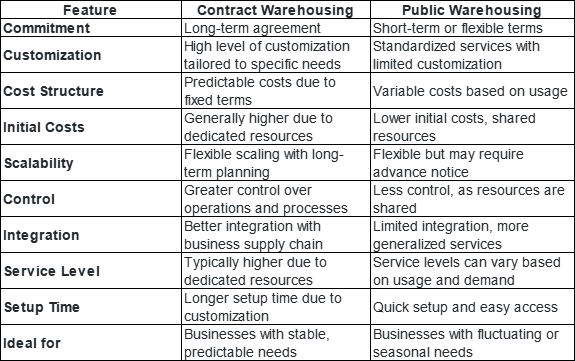
Contract warehousing vs. public warehousing
Since both contract and public warehouses generally serve the same purpose, people often conflate the two.
Benefits of contract warehousing for ecommerce
- Contract warehousing allows e-commerce businesses to tailor services to their specific needs, such as packaging, labeling, and shipping requirements. Warehouses can be configured to handle specific product types, including fragile or perishable goods, ensuring optimal storage conditions.
- While contract warehousing often requires a long-term commitment, it can lead to cost savings through predictable pricing and economies of scale. Businesses can avoid the capital expenditures associated with building and maintaining their own warehouse facilities.
- Contract warehousing providers often offer advanced inventory management systems that provide real-time tracking and reporting, helping businesses maintain optimal stock levels and reduce overstock or stockouts. Enhanced inventory control can lead to better demand forecasting and order fulfillment.
- As e-commerce businesses grow, contract warehousing can scale operations to accommodate increased inventory and order volumes without the need for significant infrastructure investments.
- By leveraging the expertise and infrastructure of contract warehousing providers, e-commerce businesses can improve their order fulfillment speed and accuracy, leading to higher customer satisfaction.
- Outsourcing warehousing operations allows e-commerce businesses to focus on their core competencies, such as marketing, product development, and customer service, rather than logistics and storage.
- Contract warehousing providers often have access to the latest technology and industry expertise, which can enhance operational efficiency and effectiveness. Businesses can benefit from the provider’s knowledge of best practices in logistics and supply chain management.
Running a business is inherently hectic. Keeping the flow of goods and services smooth is even more so. Outsourcing to LinkW logistics USA makes it easy and hassle-free for you and your business. Relying on a contracted warehouse will help you streamline the import and export of your goods and cope with unexpected changes without losing a dime.

Linkw
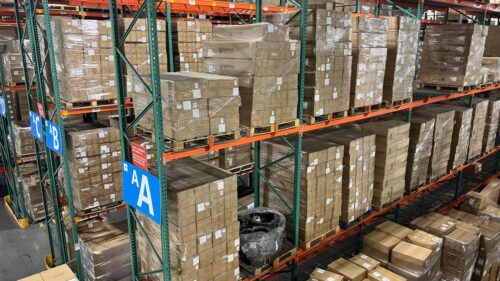
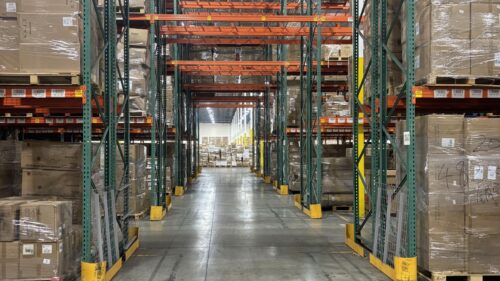
Our large-scale warehouses span 958,000 square feet across five branch offices in the US.
Table of Summary