
-

English
-
Japanese
-
Korean


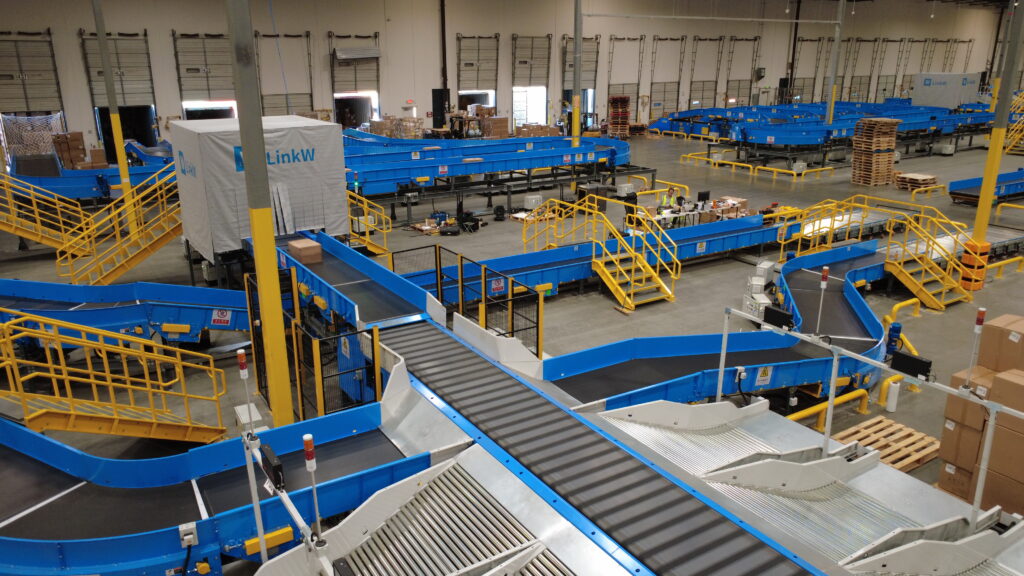
Warehouse automation has moved from competitive edge to baseline expectation. Labor shortages, rising wages, and peak-season volatility have made manual fulfillment increasingly difficult to sustain at scale. Brands now ask a sharper question: not “do you use automation?” but “what automation do you actually run, where is it deployed, and what has it changed?”
That question is harder to answer than most 3PL sales decks suggest. Many providers claim “robotics” or “advanced sorting” while running manual operations at the node that will serve your orders. Others deploy robots in one flagship facility and batch-sync inventory everywhere else. The gap between marketing language and operational reality is where fulfillment performance is won or lost.
This guide explains what real warehouse automation looks like in 2026, how to evaluate a 3PL’s claims beyond the demo, and where Linkw fits for brands that need US-based warehousing and transportation with automation embedded from port to doorstep.
What Counts as Warehouse Automation in 3PL?
Warehouse automation is not one system. It is a layered stack of technologies that reduce manual labor, increase throughput, and improve accuracy:
- Autonomous Mobile Robots (AMRs): Self-navigating robots that move inventory, totes, or pallets across the warehouse floor without fixed infrastructure.
- Goods-to-Person (G2P) Systems: Robotic shuttles and AMRs that bring inventory to stationary pickers, eliminating walk time.
- Automated Sortation: High-speed conveyor and cross-belt sorters that route parcels to the correct outbound lane by size, destination, or carrier.
- Robotic Container Unloading: Robots like Boston Dynamics’ Stretch that unload boxes from shipping containers autonomously.
- RFID and Barcode Technologies: Scanning systems that track inventory movement in real time and reduce errors.
- Warehouse Control Systems (WCS) and Warehouse Execution Systems (WES): Software that orchestrates robots, conveyors, and human workers on one floor.
- AI-Powered Orchestration: Multi-agent software that coordinates equipment from multiple vendors alongside warehouse staff.
The 3PLs that lead in automation are not the ones with the most robots. They are the ones that integrate robotics, software, and human workers into a single coordinated operation.
Why Automation Matters More in 2026
The economics of warehouse labor have shifted decisively. Autonomous robot fleets deployed by major 3PL providers have reduced labor costs by an average of 82% while increasing order processing speed by 156%, according to the Warehouse Automation Institute.
The ROI timeline has compressed. “The ROI timeline has shortened from 3–4 years to just 8–12 months,” said Marcus Chen, Director of Operations Technology at Logistics Dynamics Corporation. Major 3PL providers deployed over 47,000 autonomous robots across North American warehouses in the first quarter of 2026 alone.
Operational improvements are measurable:
- Order picking accuracy increased to 99.7% from 94.3% with human workers
- Average order processing time reduced from 2.4 hours to 37 minutes
- Peak season capacity expanded by 340% without additional hiring
- Inventory counting frequency increased from monthly to daily
For brands, the implication is simple: automation is no longer a differentiator reserved for enterprise volume. It is becoming the cost of staying competitive.
How to Identify a 3PL That Actually Uses Automation
Not all automation claims are equal. Before you sign, ask these questions:
- What specific robots are deployed? Ask for brand names (Locus, Vecna, Boston Dynamics, Exotec, Libiao) and deployment counts, not generic “robotics.”
- Is automation deployed at the node that will serve your orders? A 3PL may have robots in one facility and manual operations in another.
- What metrics have improved? Ask for pick rate improvements, error rate reductions, and throughput increases — with timeframes.
- How does the WMS integrate with robotics? A WMS that cannot orchestrate robots in real time limits automation value.
- What is the ROI timeline? Best-in-class is 8–12 months. Anything beyond 24 months warrants scrutiny.
- How does automation handle exceptions? Robots cannot improvise. Ask how the 3PL manages mismatched barcodes, damaged items, and incomplete picks.
- What is the integration cost? Shopify store owners report 23% longer setup times when connecting to robot-enabled 3PLs compared to traditional warehouses. Budget for this.
- Is the automation model flexible? Robotics-as-a-Service (RaaS) models allow capacity adjustment without large capital investment.
A partner that cannot answer these questions with specific capabilities — not vague promises — is not ready for automated fulfillment at scale.
Where Linkw Fits: US-Based Warehousing and Transportation Automation
Linkw’s automation strategy is built around a specific operational reality: inventory moves through multiple handoff points — from port container unloading to US warehouse storage, fulfillment, and last-mile delivery. Each handoff is a potential point of failure. Linkw addresses this by embedding automation across the entire US logistics chain.
Automation capabilities:
- Automated warehousing, sorting, and inventory management with RFID and barcode technologies
- Hands-free picking with robotics and wearables
- Voice-directed picking to reduce errors and speed fulfillment
- Warehouse Control Systems for automated operations and accurate inventory tracking
- AI-powered route optimization analyzing real-time data
- Narrow belt sorters and roller conveyors for automated parcel routing
Network: 5+ self-owned US fulfillment centers spanning over 958,195 sq ft, supported by an in-house fleet of 50+ port trailers and 35 interstate trucks. In 2025, Linkw processed nearly 35,000 FEUs and handled over 1.38 million cartons.
Additional strengths: US port container unloading and drayage, FTZ warehousing with dutyral, nationwide transportation, bilingual 24/7 customer support, and integration with TikTok, Mercado, Shopee, Lazada, Wayfair, and ERPs including Eccang, Tongtu, and Mabang.
Here is what Linkw’s automation stack looks like in practice:
| Automation Layer | What Linkw Provides |
|---|---|
| Warehouse operations | Automated warehousing, sorting, and inventory management with RFID and barcode technologies |
| Picking | Hands-free picking with robotics and wearables; voice-directed picking |
| Warehouse control | Warehouse Control Systems for automated operations and accurate inventory tracking |
| Sorting | Narrow belt sorters and roller conveyors for automated parcel routing |
| Route optimization | AI-powered logistics optimization with real-time route planning |
| Loss prevention | Anti-theft and loss prevention systems with smart monitoring and blockchain-secured data |
Linkw’s automation is not limited to the warehouse floor. The company operates an in-house fleet of 50+ port trailers and 35 interstate trucks, providing seamless port drayage, nationwide transportation, and last-mile delivery. For brands that need US-based fulfillment, this integrated approach means automation extends from container unloading at the port through FTZ storage, warehouse fulfillment, and final delivery — reducing the number of manual handoffs where errors and delays occur.
Other 3PLs With Notable Automation Programs
Beyond Linkw, several 3PLs have deployed meaningful automation at scale. The following are worth evaluating alongside your own order profile and node requirements.
ShipBob uses autonomous mobile robots across parts of its network, AI-powered cameras to grade returns, and an end-to-end AI suite connecting merchant software to warehouse robots. Its network includes 50 fulfillment centers across the US, Canada, Europe, and Australia.
ShipMonk has deployed Locus Robotics AMRs in Pittston, PA and Fort Worth, TX, improving pick rates by 34% year-over-year in robotics-enabled zones. It also runs an AutoStore grid pilot in Los Angeles and a Honeywell Intelligrated hybrid conveyor setup in Pennsylvania.
Geodis uses Vecna Robotics AMRs in a 600,000-square-foot Plainfield, Indiana facility, doubling picking throughput while improving safety and training speed.
GXO Logistics deployed the first autonomous industrial truck powered by KION at its Épinoy, France facility and collaborates with KION, NVIDIA, and Accenture on AI-driven material handling.
Kenco uses GreyOrange’s GreyMatter orchestration software to manage a single order’s journey across technology from multiple vendors, achieving a 20% reduction in transportation costs and 2x cases picked per hour at one site.
THG Fulfil deployed 430 Libiao Robotics sorting robots, increasing daily sortation capacity from 250,000 to 625,000 units — a 150% increase — with 99.9% sort accuracy.
CEVA Logistics uses Boston Dynamics Stretch robots for container unloading and operates the only transload facility in North America with a cross-belt sortation device, sorting 10,000 parcels per hour.
Komar Distribution Services implemented an Exotec Skypod robotic system at a 760,000-square-foot Savannah, Georgia facility, expecting up to 50% throughput increase and 30% storage density gain.
DHL Supply Chain runs approximately 8,000 collaborative robots globally and uses SVT Robotics SOFTBOT to integrate robotic systems up to 12 times faster than traditional custom coding.
Automation ROI: What the Numbers Show
| Metric | Manual Operation | Automated Operation | Improvement |
|---|---|---|---|
| Order picking accuracy | 94.3% | 99.7% | +5.4 points |
| Average order processing time | 2.4 hours | 37 minutes | -74% |
| Peak season capacity | Baseline | +340% | Without additional hiring |
| Labor cost reduction | — | 82% average | Warehouse Automation Institute |
| ROI timeline | 3–4 years (legacy) | 8–12 months (current) | -66% |
| Sortation capacity (THG Fulfil) | 250K units/day | 625K units/day | +150% |
| Case picking throughput (Geodis) | Baseline | 2x | +100% |
The ROI case is strongest for fashion, electronics, and high-volume repetitive picking operations. Small and medium-sized fashion brands using automated 3PL services are shipping 40% more orders with the same facility footprint.
Bottom Line
For brands that need US-based warehousing, port container handling, and nationwide transportation, Linkw extends automation beyond the warehouse floor. Its automation stack covers container unloading at the port, FTZ storage, warehouse picking and sorting, and nationwide transportation — reducing manual handoffs at every stage of the US logistics chain.
Before you commit to any 3PL, ask one question: can they show you specific robots, specific metrics, and a specific ROI timeline for the node that will serve your orders? If the answer is a generic “we use automation,” the evaluation is not finished.

Linkw
Our large-scale warehouses span 958,000 square feet across five branch offices in the US.
Table of Summary


