-

English
-
Japanese
-
Korean



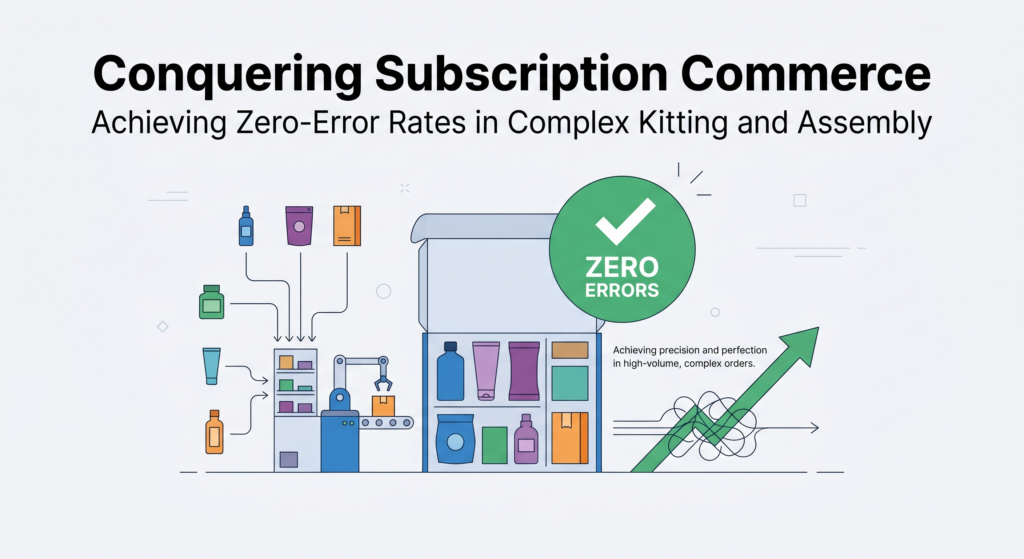
Subscription commerce operates on a ruthless margin of error. In traditional ecommerce, a customer might forgive a slightly delayed package or a crumpled packing slip. In the subscription box industry—whether it is premium skincare, curated wellness supplements, or specialty foods—the customer is not just buying the products; they are buying the curated experience.
For brands relying on Monthly Recurring Revenue (MRR), the “unboxing experience” is the ultimate retention metric. A single missing item, a misplaced insert, or a damaged component does not just result in a customer service ticket; it instantly triggers subscriber churn, obliterating Customer Lifetime Value (LTV).
To survive in this highly competitive space, brands must transition from standard pick-and-pack fulfillment to precision-engineered manufacturing. Here is how leading subscription brands are achieving zero-error rates in complex kitting and assembly operations.
The Compounding Cost of Kitting Errors
Standard fulfillment involves pulling a single SKU off a shelf and putting it in a brown box. Kitting, however, is a localized manufacturing process. It involves taking multiple independent SKUs, promotional inserts, custom tissue paper, and branded packaging, and assembling them into a single, presentation-ready unit (a new “Master SKU”).
When kitting relies on chaotic, manual processes, the financial fallout is severe:
- The Churn Multiplier: Subscription economics rely on acquiring a customer once and retaining them for months or years. An assembly error breaks consumer trust immediately, turning an expensive Customer Acquisition Cost (CAC) into a permanent loss.
- Hidden Labor Costs: Fixing a botched subscription box requires customer service triage, the cost of replacement goods, expedited secondary shipping, and the labor required to manually process the correction.
- Inventory Distortion: If a warehouse worker puts two bottles of serum into a box instead of one, not only is the current order wrong, but the facility’s inventory counts are now compromised, leading to stockouts for future subscribers.
Why Traditional 3PLs Fail at Subscription Fulfillment
Most traditional third-party logistics (3PL) providers are built for speed and volume, not precision and presentation. When a subscription brand outsources its kitting to a standard 3PL, the results are often disastrous.
These facilities typically rely on transient, temporary labor to handle month-end subscription surges. Without rigorous Standard Operating Procedures (SOPs), temporary workers quickly succumb to assembly fatigue. Placing the exact same promotional card at a precise 45-degree angle inside 10,000 boxes requires sustained focus that a standard warehouse environment simply cannot support.
Engineering a Zero-Error Kitting Workflow
Achieving a zero-error rate requires treating the subscription box like a precision-manufactured product. This involves a triad of data control, physical assembly line design, and automated validation.
1. Treating the Box as a Bill of Materials (BOM)
A subscription box cannot be treated as a loose list of items. It must be structured in the Warehouse Management System (WMS) as a strict Bill of Materials. Before a single box is built, the system must digitally verify that every sub-component—down to the exact number of custom stickers and informational pamphlets—is perfectly allocated and staged at the assembly line.
2. Technology-Driven Assembly Stations
Human error is inevitable without systemic guardrails. Modern kitting operations deploy technology to guide the physical build process:
- Pick-to-Light Systems: Workstations are equipped with lighted bins that illuminate to show the operator exactly which component to grab next, eliminating the mental fatigue of memorizing complex build sheets.
- Visual SOP Displays: Digital screens at each station display high-definition images of exactly how the box should look at that specific stage of assembly, ensuring brand-perfect presentation.
- Inline Barcode Validation: Operators scan each item as it goes into the box. If an incorrect SKU is scanned, the system physically halts the line and sounds an alert.
3. Automated Weight Verification (The Final Gatekeeper)
The ultimate failsafe in zero-error kitting is inline weight checking. Because the exact weight of every component (and the packaging itself) is known, the final assembled box has a highly specific theoretical weight. Before the shipping label is applied, the box rolls over an automated scale. If the physical weight deviates from the theoretical weight by even a fraction of an ounce—indicating a missing insert or a duplicate product—the box is automatically kicked off the line for a quality assurance review.
Securing Your MRR with Specialized Infrastructure
Scaling a subscription brand requires front-end marketing brilliance, but retaining those subscribers demands back-end operational perfection. Relying on makeshift assembly lines and outsourced, unspecialized labor is a direct threat to your recurring revenue.
To conquer subscription commerce, brands must partner with fulfillment networks that treat kitting as a dedicated discipline. By utilizing self-operated fulfillment hubs equipped with specialized kitting zones, automated validation technology, and rigorous SOPs, brands can ensure that every single unboxing experience is flawless. In the subscription economy, operational certainty is not just a cost-saving measure; it is the ultimate engine for customer retention and lifetime profitability.

Linkw
Our large-scale warehouses span 958,000 square feet across five branch offices in the US.
Table of Summary