
-

English
-
Japanese
-
Korean



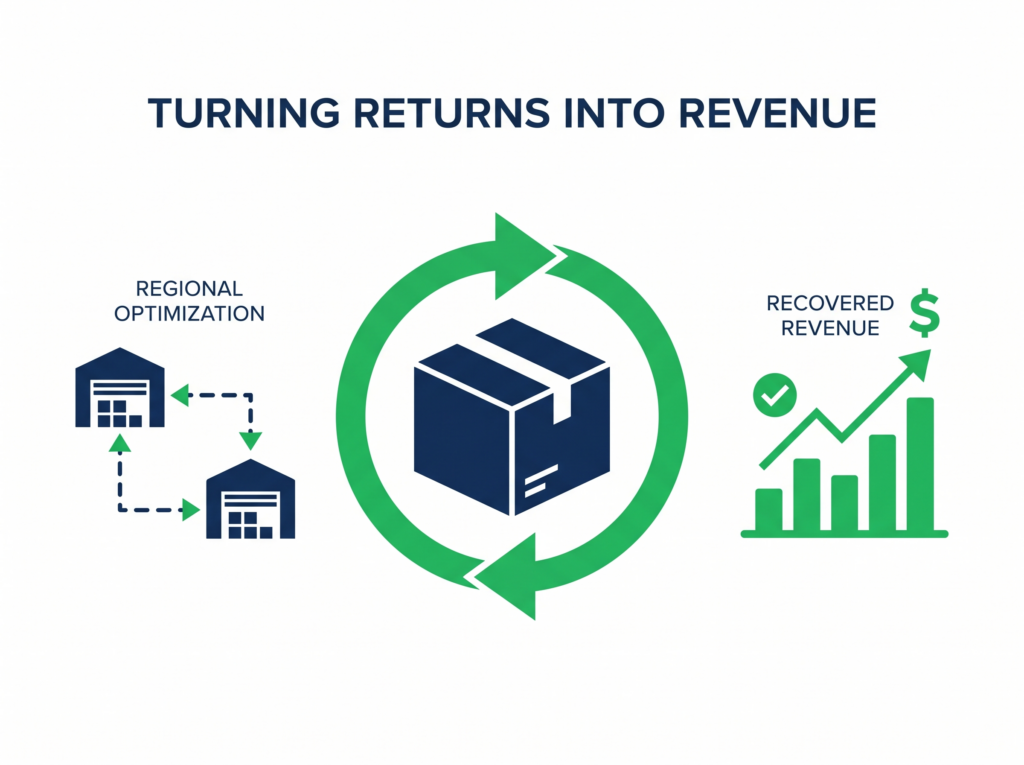
For Direct-to-Consumer (DTC) brands aggressively scaling across North America, the boardroom is typically dominated by front-end commercial growth metrics: Customer Acquisition Cost (CAC), Return on Ad Spend (ROAS), and Marketing Qualified Leads (MQL). However, as order volumes surge, an invisible profit killer consistently erodes those hard-earned margins: the reverse supply chain.
With average ecommerce return rates hovering between 15% and 30%—and spiking even higher in categories like apparel and electronics—returns can no longer be dismissed as a mere “cost of doing business.” A poorly managed return process quickly negates initial marketing wins, turning profitable sales into net-negative cash flow.
To protect and elevate overall Return on Investment (ROI), forward-thinking brand operations teams are abandoning legacy return models. They are transforming reverse logistics from a reactive operational nuisance into a proactive value driver. Here is the comprehensive playbook for salvaging your margins and optimizing the return lifecycle.
1. The Hidden Bleed: Deconstructing the True Cost of a Return
To solve the margin drain, brands must first understand that the cost of a return extends far beyond the refunded purchase price. The financial impact compiles across four distinct operational layers:
- Two-Way Transit Costs: You pay the outbound shipping to acquire the customer, and you absorb the inbound shipping label to bring the item back.
- Labor and Handling: Warehouse staff must physically receive, unbox, inspect, test, and re-bag the merchandise. This is highly manual, expensive labor.
- Asset Depreciation: Inventory is a perishable asset. Every day a returned item sits in transit or in a processing queue, its seasonal relevance drops, driving down its potential resale value.
- Customer Churn: A clunky, slow refund process guarantees the customer will never shop with your brand again, destroying their Lifetime Value (LTV).
2. Front-End Defense: The Policy and Portal Playbook
The most profitable return is the one that never happens. Intelligent reverse logistics starts before the customer even drops the package in the mail.
Implementing an automated Return Merchandise Authorization (RMA) portal is critical. Instead of relying on static PDF return slips inside the box, digital RMAs force the customer to log in, state their reason for return, and provide data. This allows brands to deploy dynamic, rule-based policies:
| Return Scenario | Intelligent Policy Action | Margin Impact |
| Wrong Size/Fit | Offer a one-click, instant exchange with a bonus $5 store credit instead of a cash refund. | Retains the revenue and protects customer LTV. |
| Low-Value Item (<$15) | Implement a “Keep It” policy; refund the customer but instruct them to keep or donate the item. | Saves $10+ in return shipping and processing labor. |
| Chronic Returner | Algorithm flags the account and dynamically charges a $7.99 restocking/shipping fee. | Deters fraudulent or highly unprofitable shopping behavior. |
3. Tech-Driven Triage: The Disposition Matrix
Once a product physically arrives at the warehouse, speed is the ultimate currency. Intelligent reverse logistics relies on strict, technology-driven grading workflows to ensure items are instantly triaged into the correct disposition channels, maximizing recovered value.
- Restock to Prime (Grade A): Unopened or pristine items. These must be immediately re-shelved and synced with the Inventory Management System (IMS) for full-price resale within 24 hours of receipt.
- Refurbish and Kit (Grade B): Items with damaged external packaging but pristine products. These are routed to a value-added services (VAS) station for re-boxing or bundled into multi-packs to hide cosmetic box damage.
- Re-Commerce and Liquidation (Grade C): Items that cannot be sold as new. Instead of destroying them, these are routed to secondary marketplaces (like eBay or Poshmark) or sold in bulk pallets to liquidators, reclaiming 20% to 40% of the baseline cost.
- Sustainable Disposal: Items that are unsalvageable. These should be responsibly recycled or donated, which can often provide tax write-offs while boosting brand ESG (Environmental, Social, and Governance) profiles.
4. Defeating the “Cross-Country Return” with Regionalization
Even with perfect grading, shipping a return across the entire North American continent is a massive logistical failure. If a customer in New York returns a heavy product, shipping it all the way back to a single centralized warehouse in California eats up valuable margin in zone-skipping freight costs.
The ultimate defense against the reverse logistics margin squeeze is a localized return footprint. Brands can completely bypass long-distance transit fees by processing returns close to the consumer markets where they originated.
5. The Infrastructure Solution: Anchoring Your Reverse Supply Chain
Executing a localized, rapid-grading return model requires robust, enterprise-grade infrastructure.
By anchoring your domestic supply chain with an expansive fulfillment network—such as leveraging LinkW’s self-operated warehousing—brands gain immediate access to approximately 1,089,000 square feet of strategically deployed capacity.
With facilities positioned across critical coastal and inland hubs like Los Angeles, New York, Dallas, and Savannah, the reverse logistics flow becomes highly optimized:
- An East Coast return is instantly routed to the New York or Savannah facility.
- A West Coast return drops into the Los Angeles hub.
- A Southern/Midwest return is processed in Dallas.
Instead of paying exorbitant Zone 8 shipping rates to move returned goods thousands of miles, items are routed to the nearest regional hub. Once inside, the inventory is rapidly audited, graded, and processed. Prime-grade stock is returned to the active shelf locally, ensuring it is positioned for rapid, cost-effective re-fulfillment to the next buyer in that specific region.
In the hyper-competitive DTC landscape, true profitability belongs to the brands that master the back-end flow. By abandoning centralized, reactive return policies and embracing an intelligent, regionalized reverse logistics strategy, you stop the financial bleed.
Leveraging multi-node infrastructure to slash reverse transit fees and rapidly restock pristine inventory ensures that returns are no longer just a cost of doing business—they are a tightly controlled mechanism that safeguards your brand’s growth margins.

Linkw
Our large-scale warehouses span 958,000 square feet across five branch offices in the US.
Table of Summary


